

Why More HVAC Techs Are Charging by Weight Again
Superheat and subcooling tell you if a charge is right. A scale is how you get it right the first time, without guessing your way there.
By Tom Reyes · September 5, 2026
Ask ten HVAC techs how they charge a system and most will say superheat and subcooling: hook up the manifold, clamp a temperature sensor to the line, and adjust the charge until the numbers land in spec. That method works, and it's how most systems get fine-tuned in the field. It's also not how you get a charge right the first time on a system you're charging from empty, and it's easy to get wrong in ways that don't show up until later.
What superheat and subcooling actually verify
Superheat charging is used on fixed-orifice metering devices (a capillary tube or a piston), and it's really a safety check: it confirms the evaporator is fully vaporizing refrigerant before it reaches the compressor, so you don't slug liquid into a compressor that isn't built to handle it. Subcooling charging is used on TXV and electronic expansion valve systems, and it confirms the condenser is fully condensing refrigerant and feeding the metering device enough liquid to work with. Both methods are reading the system's behavior, not the amount of refrigerant in it directly.
A detail that actually changes your numbers
An uninsulated temperature sensor picks up 3 to 8°F of ambient air influence, which throws off both superheat and subcooling readings without you knowing it. If you're not insulating the sensor with foam tape or a clamp cover, your "in spec" reading might not be.
Where weight-based charging fits in
Manufacturers publish a factory charge weight for a reason: on a new install or after a full evacuation, you know the exact target before you connect a hose. A refrigerant scale lets you hit that number directly by weighing what goes into the system, rather than trickling refrigerant in and checking superheat/subcooling after each addition. That's faster on a from-empty charge, and it removes the ambient-sensor error above from the equation entirely for the initial charge.
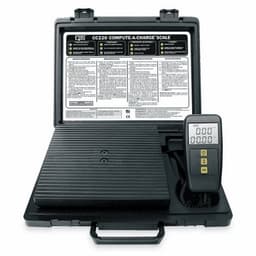
CPS Products CC220 Refrigerant Charging Scale, 220 lb
Weighs refrigerant in and out during charging and recovery, accurate enough to hit a target charge rather than guessing by pressure.
$304.59
View on Amazon
In practice, most techs use both: charge to the manufacturer's weight spec with a scale to get in the right neighborhood fast, then verify and fine-tune against superheat/subcooling once the system is running, especially on a repair where the original charge is unknown or partially lost. Weight gets you close efficiently; superheat and subcooling confirm the system is actually behaving correctly once it's running.
Where this doesn't help
A scale doesn't tell you anything about a system that's already running with an unknown amount of refrigerant in it, like a service call on an existing unit. There, you're back to superheat/subcooling to evaluate what's actually there and correct it, because you have no reliable starting weight to work from. Weight-based charging is a from-empty tool, not a universal replacement for the temperature-based methods.
The bottom line
This isn't old method versus new method, it's two different questions. "How much refrigerant is in this system" is answered by a scale. "Is this system running correctly" is answered by superheat and subcooling. A tech doing new installs and full recharges without a scale is charging by feel when a faster, more direct number is sitting right there.
Relevant tools
Related reading

Is a $400 Multimeter Actually Better Than a $100 One?
The difference isn't accuracy. It's what happens the one time you're wrong about which wire is hot.
By Tom Reyes

Cordless Finally Caught Up to Pneumatic
Brushless motors and high-output batteries closed most of the gap. They didn't close all of it, and the part that's left matters if you're on your feet all day.
By Tom Reyes